Past Presence

Photographer: 
Robert Benson

Some houses, not unlike people, just seem to be naturally warm in spirit. Such is the case with this handsome 1790s colonial in a tiny town in the Berkshires. Perhaps it’s a reflection of the care and attention the original builders paid to the design and materials. Maybe the walls still hold traces of the familial affection and hospitality that filled it through the years. Or it could be just a happy accident of feng shui. Whatever the reason, the house seems almost to glow with good karma.

This home has been well loved from the very start. One family occupied it for much of its first century of life. In the nineteenth century it became a popular inn, hosting such luminaries as Mark Twain and Grover Cleveland (who, in his post–White House years, enjoyed fishing in the nearby brook). Over time, an ell, a second story, a porch and a kitchen were added on to the original structure, each change only augmenting the house’s charm. In the 1970s, Nat King Cole’s widow, Maria, bought the house and gave it a thoughtful renovation that updated its features without erasing its character. The house changed hands once again, and then, in the early 1990s, a young New York couple, visiting the Berkshires with their infant and toddler sons in tow, happened by it and were smitten. “We had just bought an apartment in the city, so we weren’t really looking for a second home,” the homeowner recalls. “But it was a beautiful house on a beautiful road in a town we’d always sort of coveted, and the price had just been reduced.”

Husband and wife loved the house just as it was—a lucky thing, since they couldn’t afford to turn it into a showcase. “We had everyone’s leftovers, a total mishmash,” the wife says. “It was fine, because the kids were still writing in crayon on the walls at that point.”

Seventeen years later, with the boys on the verge of adulthood, the couple felt the time was right for a facelift, not just to bring the house into the twenty-first century, but also to make it a suitable year-round retreat now that they were almost empty nesters. Entertaining friends and family is a priority for the pair, so the upgrade they envisioned would include an addition. “Our main need was for a big room for gathering and socializing,” the wife says.

A house with such a storied past deserved a respectful renovation, they felt. They found a like-minded partner in architect Kristine Sprague of Lenox, Massachusetts. Sprague went through the whole house, replacing leaky old windows with new six-over-sixes, modernizing the bathrooms and giving all the fireplaces new stone surrounds, hearths and mantels. The biggest part of the job, however, was the new great room, a space of about 750 square feet with soaring double-height ceilings and a full basement.

Such a large room wouldn’t have been found in a Colonial-era home, of course, but like all the people who added to the house before her, Sprague devised a way to make the new section look and feel thoroughly integrated. Mirroring the old house’s post-and-beam construction, Sprague applied a textured Venetian plaster to the room’s walls and ceiling, then added old-looking fir beams. “If I only need a couple of old beams I can usually find them,” she says, “but in this case we needed so many, I used new beams and had them distressed to look old.”

At a salvage yard in Hudson, New York, she found the antique half-round windows that sit high on the great room’s walls, flooding the space with light. The room’s focal point is the fireplace, with its herringbone brick interior and wide fieldstone surround that narrows as it rises to meet the ceiling.

New York City designer Keith Lichtman, who worked with the couple on their urban apartment, was happy to be invited to dress up the interiors in their country house. “Of course,” he says, “this house has an entirely different vibe from their city home. Design has to be about respecting the architecture of a home.”

This home called for a design that is traditional at its core but not a literal interpretation of its colonial roots, he explains. “I didn’t want it to be a precious museum exhibit. I wanted it to be traditional, but fresh and clean—beautiful, but for comfortable living.”

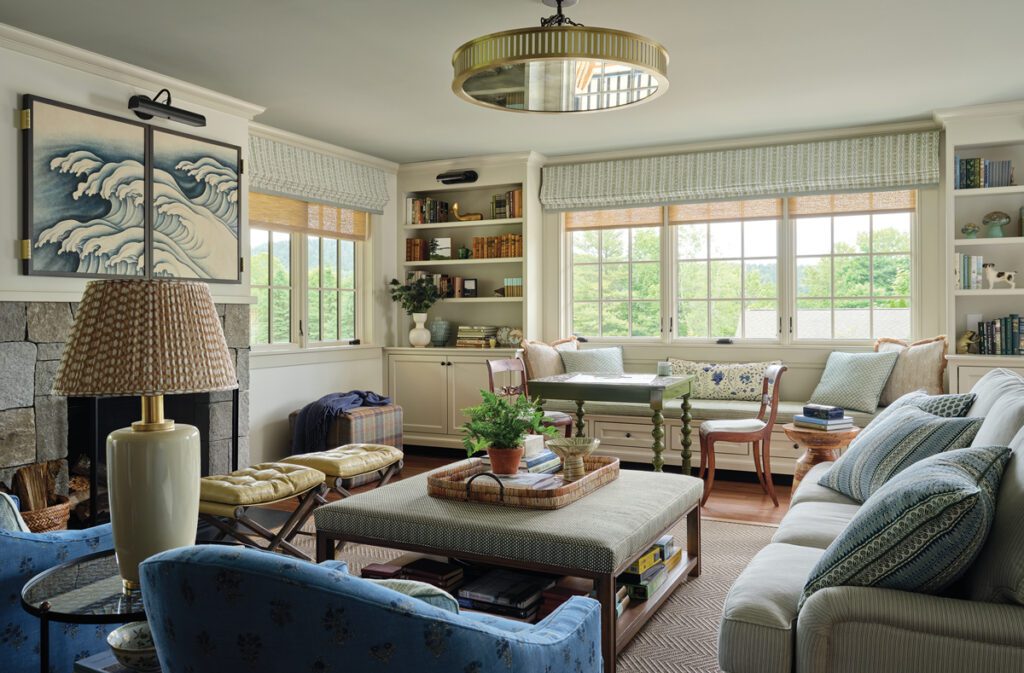
Lichtman set the tone by dressing the home’s many windows simply, sticking mostly to Roman shades or panels in luxurious fabrics. “There are no fussy details, no swags or jabots,” he says. He chose furniture pieces with traditional shapes, like the rolled-arm sofas of the great room, then covered them in fabrics in solid colors or small geometric patterns for a more current look. Likewise, he scouted out table and floor lamps with classic bases, then topped them with shades that have a cleaner, more contemporary shape.

Tradition asserts itself here and there, in antique pieces like the secretary in a corner of the home’s original living room (called a keeping room in Colonial times, and now used as a sitting room), as well as in the reproduction mid-nineteenth-century wallpaper in the dining room. A palette Lichtman calls “delicious” in shades of apricot, gold and rust leads the eye from room to room. Only the kitchen deviates, where a scheme of demure French blue takes over.

Things take a glamorous turn in the second-floor master bedroom, where Lichtman outfitted the space in a trellis-patterned wallpaper that gives the walls a hand-painted look and dressed the twin windows behind the bed in vivid green crinkled silk panels.

Despite all the renovations, some things remained unchanged, like the simple wooden staircase to the second floor, the wide-plank pine floors of the old sections of the house and a number of handwrought door latches—plus one thing the homeowners feel a special connection with. “In our bedroom, there was an old pane of glass with ‘1919’ and ‘Fred’ scratched into it,” the wife relates. Unable to bear tossing it away, the couple had it added to a basement window. “We’ll never know who Fred is,” the wife says, noting that, oddly enough, it’s the middle name of both her husband and one son. “But it makes me feel a connection to the people who’ve been here before, and I’ll have a connection with those who come after me.” •

Architecture: Kristine Sprague
Interior design: Keith Lichtman, KL Interiors
Builder: Matt Donald

Start the Conversation

Online Design Center Premium