A Labor of Love
A southern Rhode Island farmhouse carefully restored and dressed up with acres of gardens is a testament to its owner’s talent as a designer—and to her fearlessness about hard work.
Nancy Taylor wields a mean pickaxe. When she bought her colonial farmhouse in Westerly, Rhode Island, the woods on the almost 100 acres had grown so freely for so long, the house itself was nearly hidden. Taylor went to work, eking out time from her Providence-based interior design business to spend long weekends clearing the land. “It took a couple of years with the pickaxe,” she says.
But, oh, the treasures she uncovered. Under masses of snarled tree roots lay yards of craggy granite ledge. Deep in the woods stood a wonderful little garden shed. “It was so buried by woods, I didn’t know it existed,” she says.
Taylor has sold off parcels of her land (contingent on its remaining undeveloped), so that now the farmhouse sits on a more manageable fifteen acres. Four of those acres hold gardens of every conceivable type—a raised vegetable plot framed by cedar logs from trees felled in the woods out back, shade gardens, perennial borders, rose beds, herbs, berry bushes, even a small orchard of fruit trees—all designed, planted and tended to by Taylor. “I was a real novice when I started,” she says. “I did a lot reading and made instinctive decisions.”
Her instincts were spot-on, judging from the fragrant rosebushes blooming in full glory, the massive azaleas with their heartbreakingly blue blossoms, and the throngs of colorful flowers waiting to be cut and arranged in vases.
The old house hadn’t fared any better than the land, but Taylor knew the minute she saw it that it was a true gem. “I fell in love with it on sight,” she says. “I knew immediately I would have this house.”
The three-story, shingled house had been in the same family since it was built, in 1776. “It was a board and batten house with, of course, no electricity or indoor plumbing, originally,” Taylor says. “Over the years it had been modernized and added onto, but it had just one lightbulb in each room, with exterior wiring.”
She lived in the house for a year and a half before undertaking a complete renovation, a task her brother, Daniel Stadt, came up from Atlanta to help out with. “We did the kind of major renovation where you take every single thing out of the house, label it and store it,” Taylor says. Many of the materials in the house were restored and reused. The chimneys were replaced, but Taylor made sure they look just like the originals.
After replumbing, rewiring the house and replacing most of the sill, it was time to put the pieces back together. “I saved every toilet, every sink, every door and every window and put them all back,” the designer says. “Some of the windows were the original windows and they were built so perfectly that with restoration, they’re beautiful.”
The house, like most built in colonial times, had many small rooms. “At first I thought it should have fewer, bigger rooms,” Taylor says. “But after living in it for a while I realized it was just right. When you think of the big rooms we work with now, we’re constantly taking them and making smaller, conversation-sized spaces within them.”
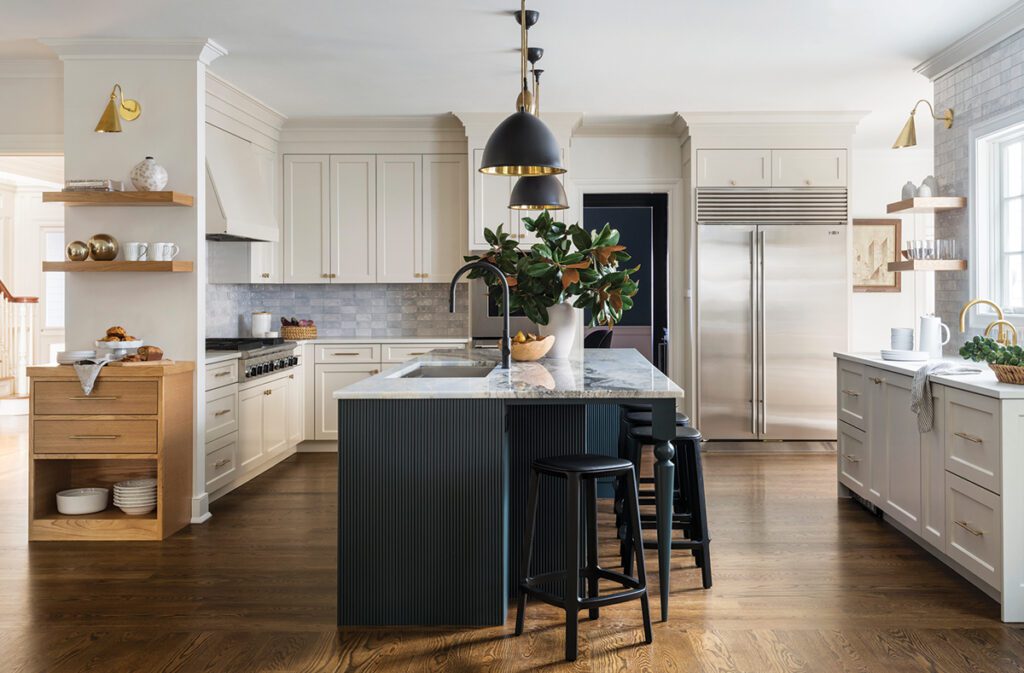
Taylor turned the biggest room in the house, a former dining room, into an entry foyer to lend the home a sense of space. She also gutted a wing that had been added in the 1950s, converting it into a large kitchen with an informal dining area and plenty of counter space. Taylor covered the kitchen ceiling with rough board reclaimed from an 1836 house. ‘It’s a wonderful, textured ceiling that helps this room feel like it’s part of a colonial house,” she says. Rustic limestone covers the floor, and kitchen counters are a mix of teak and gray-blue granite, with plenty of surface area for cooking and for putting up jams and jellies from the fruits of her gardens.
A small open porch that extended from the wing was converted into a sun-washed formal dining room, with windows on three sides. A corner cabinet, original to the house, holds Taylor’s collection of pink lusterware. Above the white beadboard walls, a ceiling painted pale pink plays off the color of the lusterware. “It gives the room a pretty glow,” says the designer. “There is a kindness to the light in this room.”
The other fourteen rooms—including the seven bedrooms—retained their original size and shape. Original floorboards and ceiling boards were restored and reinstalled, and Taylor has furnished the rooms in period pieces and fabrics. In the library, with its pale green walls and sheer white curtains letting the light stream in through the original windows, a chaise covered in a toile print fabric encourages readers to curl up for an extended session with a good book.
In the master bedroom, white beadboard walls and a natural beadboard ceiling glow in the light that flows in through windows on all four walls. Just outside the bedroom, the oak-paneled stairwell pays homage to the home’s history. “The oak boards were the very first boards used in the construction of the house, so I gave them the place of honor at the very heart of the house when we reassembled it,” Taylor says.
Taylor has literally shed blood, sweat and probably a few tears in bringing the old farmhouse and grounds back to life. But every moment has been worth it. “I don’t know if anyone else can see in it what I see in it,” she says of her house and gardens. “But I am so smitten.”
Interior architecture and design: Nancy Taylor, Taylor Interior Design
Restoration: Daniel Stadt
Sponsors
![]() | Sharing our editor's share...upcoming guest bloggers for New England Home. http://t.co/FMmlq4VO Friday Favorites: Architectural candles, designer vignettes and a garden book by one of America's first female... http://t.co/Hd3uQMkC A blog post for anyone who ever enjoyed playing with clay. http://t.co/g4ka0YRj |
Search our Online Design Center
Search from hundreds of home services, products, destinations, and real estate opportunities