Field of Vision
A contemporary new house on a swatch of historic farmland on Vermont's Lake Champlain forges an amiable bond with the past while looking resolutely forward.
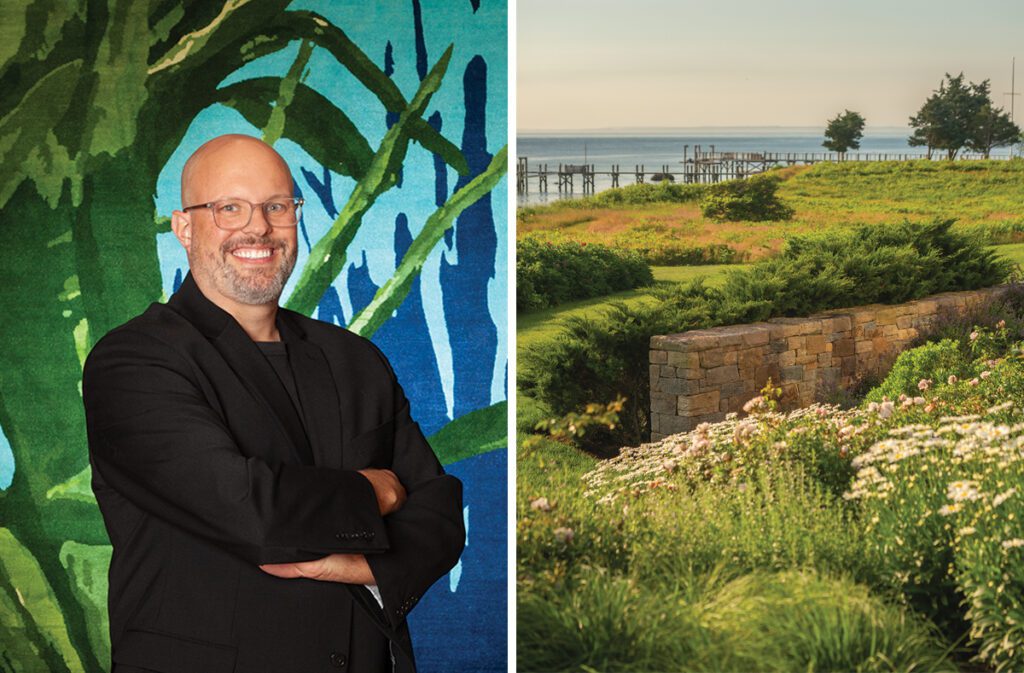
To understand fully what a marvel this Vermont house is, you have to know something about its location. The sweeping views across pastures that tumble toward majestic Lake Champlain are phenomenal. Shifting daylight and the changing seasons bring rhapsodic moments when sky and water seem to converge. Sometimes on a wintry afternoon the horizon is painted silky pink, and come full moon, the distant Adirondacks glow silver.
Adding to its magic, this newly constructed modern home sits on a seriously historic site. The property was parceled off in the 1980s by Shelburne Farms, the 1,400-acre agricultural estate built by William Seward and Lila Vanderbilt Webb and originally landscaped by Frederick Law Olmsted. As you make your way to the front door of the home, you travel past the glorious eighteenth-century barns of the old farm, now a nonprofit environmental education center. Surrounded by an almost palpable sense of history, you crest the hill and suddenly there it is—a 6,500-square-foot house whose exaggerated horizontal lines clearly speak to the future.
Remarkably, the juxtaposition of old and new is congenial. The house is modern, yes, but not out of place. It complements the rugged site, mimicking a stone outcropping with its low-slung profile. And even from a distance, the high-quality craftsmanship is evident. Few remember the 1970s house and barn that once stood here. Not meriting preservation, the structures were dismantled and turned over to a recycling company. Only the barn’s foundation remained, and it became the starting point for the 1,550-square-foot Japanese-inspired guesthouse.
“The project really began with a stable and guesthouse,” says Brian Mac, principal architect of Birdseye in Richmond, Vermont. “I used the latter as a study for the main house, creating a vocabulary and a composition of forms and materials that I then expanded. All three buildings are in concert.”
A full-service company, Birdseye oversaw all facets of the project, from construction and custom cabinetry to built-ins (including beds) and metalwork. Such committed involvement streamlined the project and assured that no minute detail slipped by. In contemporary construction, forgiving moldings aren’t an option. Every seam had to be perfect, and it is. “It was a good journey from start to finish—a total collaboration with the interior designers and the owner and a great deal of fun,” Mac recounts modestly.
The cedar-clad house seems at one with the landscape, which Mac credits in large part to the contributions of landscape architect H. Keith Wagner of Burlington, Vermont. But for all its quiet respect of its environs, the home also has elements of surprise, like the windows that race along the entire lake-facing rear elevation. Mac didn’t allow design to trump sustainability, either. In addition to its thermally efficient construction, for example, the house includes a geothermal heating and cooling system.
Happily, the home’s interiors don’t fall short of its impressive architecture. Eric McClelland and Peter Lunney of Toronto-based Fleur-de-lis Interior Design display an almost uncanny talent for pairing innovative materials in unusual ways for a seamless fit. Generous applications of hot- and cold-rolled steel, granite, marble, onyx, limestone, leather and wool make for a grand mix that’s also simplistic, McClelland says: “We’re letting the outside in, allowing the views to dictate the interior. It’s a sort of glamorized version of the Vermont landscape.”
The entry epitomizes this motif. The owners pass through their custom front doors onto a walnut runway framed with variegated limestone. Above, a shaft embedded with lights mimics a constellation. The glow illuminates a sculpture that sits in a Chinese-red niche with a drawer wrapped in goat skin. “The Chinese red is symbolic,” McClelland explains. This is, after all, a home with Asian flavor; red in China corresponds with fire and symbolizes good fortune and joy. Behind the niche, the back stairwell descends from an office lined with antique maps to the lower level, where dual guest rooms, an exercise room, lap pool and spa wait.
The office and generous master suite occupy this wing as well. The public areas—library, kitchen, dining and great rooms, along with a second office and sunroom—claim the other side of the house. Every space is delineated by its own exquisite marriage of materials. Nothing is ordinary, and much is downright extraordinary. Take the glacier-like raw steel sculpture that protects the media room, the only spot that doesn’t embrace the view. Or the great room’s sophisticated walnut, granite and steel hearth. Flanked on either side by glass, the soaring hearth is a sculpture in itself. The hand-tufted silk and wool carpet designating the nearby sitting area evokes the granite’s veining, or maybe bare winter trees—or possibly both.
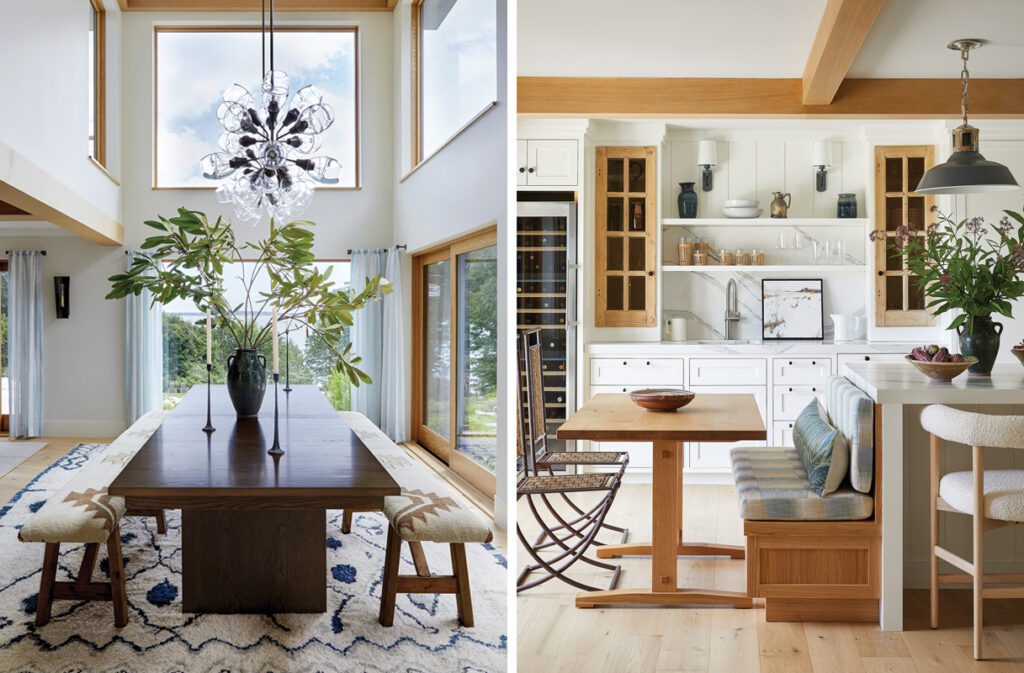
Since every item in this house is integral to the design, lighting fixtures also serve as architectural elements. In the dining area, rather than adhere to the usual light-centered-over-table formula, a spectacular galaxy of hand-blown bubbles by Canadian glass artist Gregor Herman favors the buffet. “We used the chandelier to give an unorthodox division to the space,” McClelland says.
In the master bedroom, the designers created a stunning ceiling plane with recessed lights nesting in an Ultrasuede leather grid. The fabric’s luxurious warmth plays off the wall of mother-of-pearl tile framed with bird’s-eye maple that rises behind the bed. An exotic French marble adorns the fireplace. “It’s an old-world marble—one you wouldn’t expect to find in a modern house,” McClelland says with delight.
Armani marble covers the vanity and surrounds the tub in the master bath, where the owners have piled some weighty crystals on the floor to promote serenity. As in all the other rooms, the atmosphere is sophisticated, but with an underlying current of rusticity. Most of all, there’s a sense that these spaces will endure.
Without a doubt, the skillful combination of beautiful architecture and marvelous materials has produced a house as memorable as those barns painstakingly crafted centuries ago. •
Architecture: Brian J. Mac, Birdseye Design Studio
Interior design: Eric McClelland and Peter Lunney, Fleur-de-lis Interior Design
Builder: Birdseye Building Company
Landscape architecture: H. Keith Wagner
Sponsors
![]() | Sharing our editor's share...upcoming guest bloggers for New England Home. http://t.co/FMmlq4VO Friday Favorites: Architectural candles, designer vignettes and a garden book by one of America's first female... http://t.co/Hd3uQMkC A blog post for anyone who ever enjoyed playing with clay. http://t.co/g4ka0YRj |
Search our Online Design Center
Search from hundreds of home services, products, destinations, and real estate opportunities