![NEH-Logo_Black[1]](https://b2915716.smushcdn.com/2915716/wp-content/uploads/2022/08/NEH-Logo_Black1-300x162.jpg?lossy=1&strip=1&webp=1 "NEH-Logo_Black[1]")
Dressed to Impress
July 31, 2012
Text by Dan Shaw Photography by Miki Duisterhof Produced by Karin Lidbeck Brent


There’s an old adage that says you only get one chance to make a first impression. But when it comes to houses, you usually get two chances: both the driveway and entrance foyer are opportunities to set a tone and frame expectations. When Woodbury interior designer Carole Winer-Sorensen first saw the manor house in Litchfield County that her clients were buying, she was impressed by its curb appeal, and she took her decorating cues from the gracious forecourt, the rustic stone walls and the ivy cascading over the white-brick residence.
Though it had been vacant for two years, the house felt fresh and airy due to a not-so-long-ago facelift by an architect from Charleston, South Carolina. The rooms had elegant proportions and good bones, though Winer-Sorensen knew that some delicate negotiations would be required to turn it into a family home that combined Old World grace and twenty-first-century practicality. “My job was to blend the preferences of the husband, who already owned antique furniture and modern art, with the more contemporary sensibility of his soon-to-be wife,” says Winer-Sorensen. “The big challenge: I was supposed to have everything ready in time for their wedding in seven months!” Fortunately, Winer-Sorensen owns Country Loft Antiques in Woodbury, so she was able to shop for many items in her store, a converted eighteenth-century barn with a French provincial flavor, where her clients had first discovered her.
Winer-Sorensen instinctively understood how to furnish the foyer, which has limestone floors, walls of double-hung windows on two sides and a view through the living room to the formal garden beyond. She chose several Louis XVI pieces—a center table with a marble top, a pair of chairs from the set in the dining room and a chalky white bench upholstered in zebra print—that have a formality appropriate for a country house. To keep the entry from feeling too studied, she added an umbrella stand made of silver boots for a bit of whimsy and a terra-cotta Chinese warrior that lends an air of exoticism.
If the foyer doesn’t make a lasting impression it’s only because the living room is so breathtaking. The designer’s decision to forgo draperies gives the space the ambience of a conservatory. “The view to the garden is so spectacular,” she says, pointing out how the half-hexagonal bay makes you feel like you’re in the midst of the landscape. “Why would you want to hide this view? It’s very private so there is no need for curtains.”
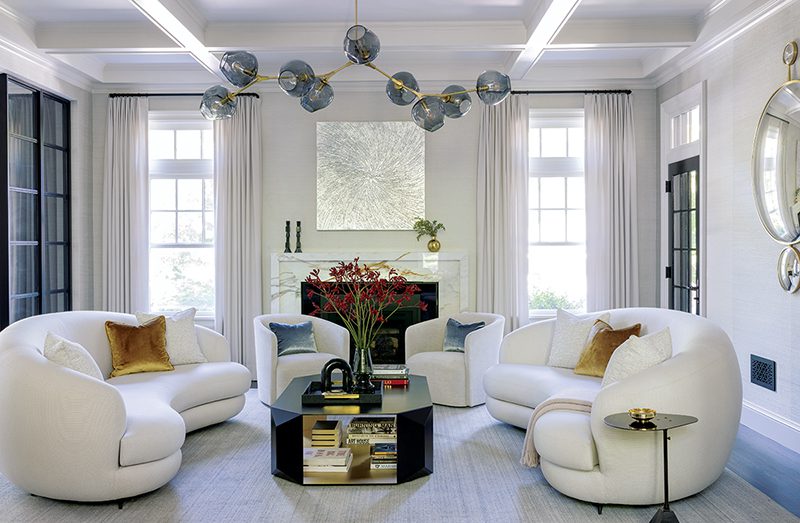
The decoration of the bone-colored living room revolves around a floating banquette that Winer-Sorensen designed to the homeowners’ specifications. “They texted me a photo of something they saw in the lobby of a hotel while on a vacation in Greece,” says Winer-Sorensen, who called on Tudor House in Hamden to produce her custom design. “We placed tape on the floor to make a template so we’d get exactly the right size.” With carved maple legs and lavender velvet upholstery, the banquette is an ambidextrous piece used for lounging while watching TV or for multiple conversations among up to eight people during a cocktail party.
Two other furniture groups lend a sense of balance to the living room. In the windowed alcove, Winer-Sorensen placed a pair of cream-velvet-covered Louis XV chairs and a Louis XV settee. She turned a duo of antique bronze candelabra into lamps that she topped with black parchment shades for contrast in the ethereal space. At the other end of the room, in front of the fireplace, a pair of swan-armed Empire chairs flank a Napoleon settee. Winer-Sorensen had these mahogany pieces painted with a faux strié finish, upholstered in a cream strié velvet from Lee Jofa and trimmed in antique-finished Houlès nailheads.
Winer-Sorensen took a similar plain-and-fancy approach in the dining room, dressing up the fourteen-foot-long rough-hewn table the owners had previously purchased by placing it atop an enormous nineteenth-century blue-and-gray Persian rug and surrounding it with Louis XV–style painted chairs covered in an icy gray linen. “I had the walls painted a light pewter-gray so that the paintings and vintage black-and-white photographs would pop,” she explains.
Gossamer voile curtains provide a touch of femininity while silver-plated rods and rings add shimmer, complementing the crystal chandelier and contemporary silver candlesticks that the owners received as a wedding gift.
Though large and recently renovated, the kitchen lacked pizzazz. But with a few significant tweaks, it’s now as glamorous as it is functional: a new custom brass-and-stainless exhaust hood shaped like a chimney became a focal point; black soapstone counters replaced ordinary granite ones; glass fronts were added to several cabinet doors; and new brass bamboo hardware provided a touch of Far Eastern sparkle.
Winer-Sorensen gave the study and library a more traditional look, hanging lush curtains of gold silk on fluted wood rods to complement the cocoa-brown walls and gold-leafed ceiling. She chose a First Empire mahogany table for a desk, pairing it with a modernist cognac-colored leather chair and an antique escabeau that acts as a bookcase. Overflowing with books and family photographs, the room is cozy but not cluttered. It has a timeless, Old World feel with its big Chesterfield leather sofa and an ornately carved nineteenth-century English walnut chair.
Equally luxurious, the master bedroom is a sophisticated oasis. “They wanted it tranquil and filled with light,” says Winer-Sorensen. The centerpiece is a reproduction American mahogany four-poster bed with a graceful curved canopy of Fortuny pleated silk that the designer also used for the petticoat. By the fireplace, matching natural linen chairs are perfect for an intimate tête-à-tête. In the bay, a chinchilla throw is draped over an early nineteenth-century tufted chaise, creating a poetic vignette framed by diaphanous white curtains trimmed in gold and held back by chunky brass pulls.
When they look out the window, the owners have a truly romantic view: they were married in the garden, which was planted according to their wishes in just three months. “We literally started with nothing except the stone walls,” says landscape designer Kurt Klimak of Klimak Horticultural Services in Woodbury. “The previous owners had removed every single bush and plant.”
The new owners wanted a formal European garden, which would normally take years to mature. “I had to find sixteen juniper spirals that were exactly the same size,” says Klimak. “We planted 700 flats of pachysandra, 4,000 fall bulbs and the fastest-growing boxwood I could find. We made the paths out of Connecticut river gravel so the bride would not slip as she walked down the aisle.”
It was an enchanting wedding, says Sorensen-Winer—no doubt, given the appealing setting—one one that left both newlyweds and their guests with a lasting impression. •
Interior design: Carole Winer-Sorensen, Country Loft Antiques
Landscape design: Kurt Klimak, Klimak Horticultural Services
Share






You must be logged in to post a comment.